

Seven members of the Mount Community embarked on a three-day pilgrimage through Emmitsburg, Gettysburg, and Baltimore to reflect on Saint Elizabeth Ann Seton’s enduring legacy of education, service, and faith.
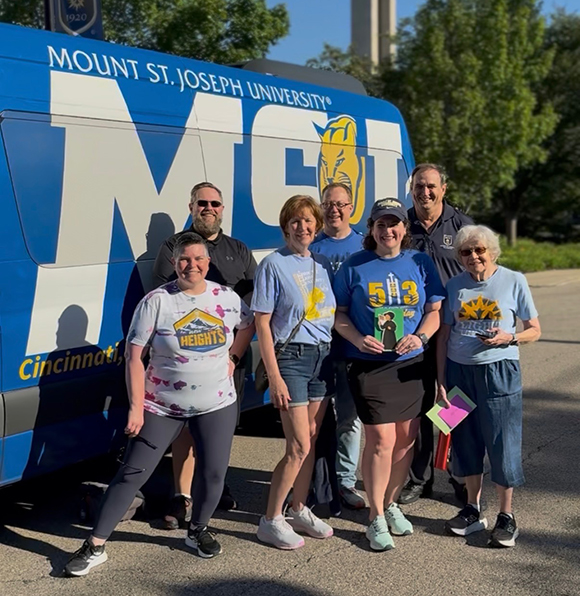
Day 1: “Humility Forms the Heart” in Emmitsburg, Maryland
Inside the quiet, picturesque valleys of Emmitsburg, Maryland, the pilgrimage began where the roots of our Sisters of Charity heritage run deepest. Under the theme of quiet reflection titled, “Humility Forms the Heart,” Day 1 unfolded into a journey back in time to the legacy that still shapes our campus community today.
The tour began at the National Shrine of St. Elizabeth Ann Seton. Stepping into the museum, the group traced back to St. Elizabeth's life, from her early days as a devoted wife to her husband William, to her journey to the Catholic Church, to her path as the founder of the Sisters of Charity, and her eventual canonization to Sainthood.
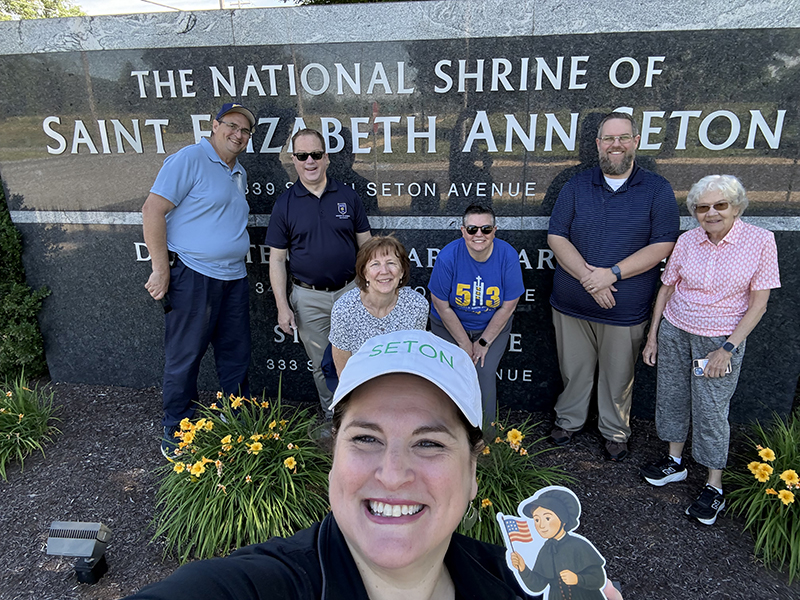
In photo: Pilgrims at the entrance of the National Shrine of St. Elizabeth Ann Seton. From left to right: Steve Ober, Joe Shadle, Kathy Hurley, Dr. Erin Hofmeyer (in front), Michelle Arnold, Greg Goldschmidt, and Sister Joyce Richter, SC.
The journey then transitioned from sacred stories to sacred spaces, as the group went from learning about her legacy to walking the very paths St. Elizabeth walked. The historic grounds of the original Sisters of Charity Motherhouse felt like stepping directly into history. The group toured the Stone House, which was the original birthplace of the community where St. Elizabeth, her daughters, and thirteen other Sisters first lived in the early 1800s. Nearby stood the White House, the subsequent main Motherhouse and school that eventually housed over a hundred Sisters and local boarding students.
Standing on the main floor, the architectural and spirit of the original Sisters' chapel seemed to echo across time, inspiring the modern elements of the Mount’s Mater Dei Chapel. The tour then entered into the private study; The quiet space where St. Elizabeth drew her final breath.
Walking through the birthplace of the school brought a powerful realization of St. Elizabeth's revolutionary approach to learning. While most women of her time only learned basic literacy, she created a practical education to prepare them for independent lives (Betty Ann McNeil D.C., 1996).
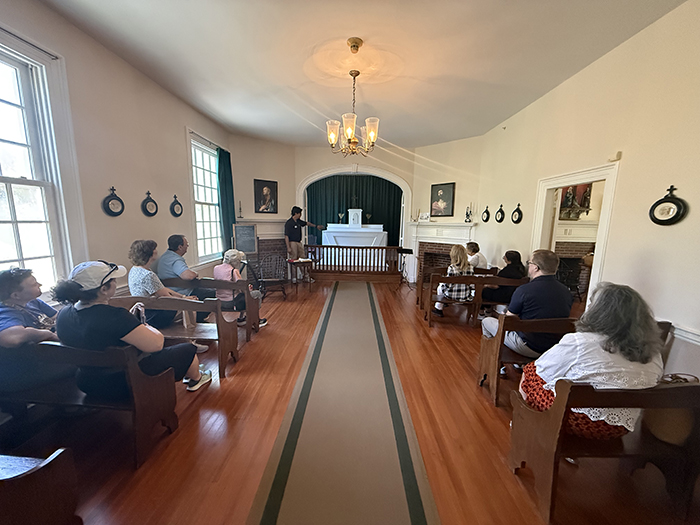
In photo: The White House Chapel, Emmitsburg, MD
“At Emmitsburg, learning that the curriculum for the St. Joseph Academy included bookkeeping, history, and language for women stopped me in my tracks,” said Assistant Professor & Assistant Director of Clinical Education Department of Physical Therapy, Erin Hofmeyer. “In a culture that had not yet deemed these skills worthy of women, she gave them anyway. As an educator myself in the Doctor of Physical Therapy Program at the Mount, I found myself asking: What are the skills, the habits of mind, the capacities for resilience that I can cultivate in my students so they are ready for the future of their profession — even the parts of it we cannot yet foresee? Her spirit of 'hazard yet forward' feels like a call I want to answer in my own classroom.”
Outside, the group walked the historic cemetery to view St. Elizabeth’s original resting place. Here, she was surrounded by her family and early companion, Sister Bridget Farrell, mother of Mother Margaret George who would go on to found the Sisters of Charity of Cincinnati. After a walk through the Seton Legacy Garden, which celebrates the global Federation of Charity including the Sisters of Charity of Cincinnati, the group gathered to celebrate Mass in the grand Basilica where they paid respects at St. Elizabeth's tomb.
Following Mass, the pilgrimage took a unique turn that beautifully connected the Mount’s heritage with modern-day service as they ventured down the road to the National Fire Academy. The group wandered the National Fallen Firefighters Memorial and Chapel, the original site of the White House before its relocation. They learned that this very chapel served as Sr. Seton’s primary shrine until her remains were moved to the Basilica in the 1960s.
“It is hard to put into words just how connected I felt to Elizabeth Ann Seton as her mission was to help people,” says the Mount’s Fire Inspector Steve Ober. “In my career as a firefighter, I felt that connection in Emmitsburg where she started her school, which became St. Joseph College and is now the site of the National Fallen Firefighters Memorial. To know a Saint walked the grounds of such a meaningful location for me was just awe inspiring.”
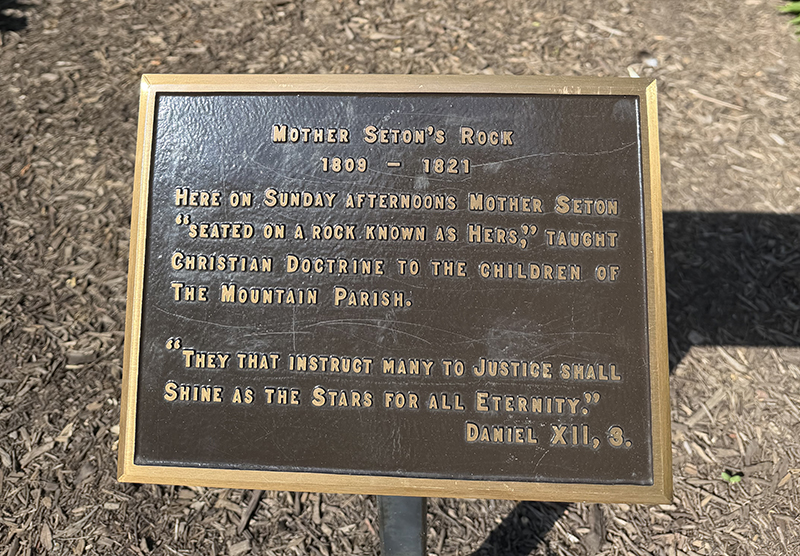
In photo: The rock where St. Elizabeth taught at the top of, and what is now known as the National Shrine Grotto of Lourdes
As they concluded a day of deep historical exploration, the group hiked the serene National Shrine Grotto of Lourdes at Mount St. Mary’s College. As they looked out over the mountainside where St. Elizabeth once taught the children of the mountain parish, the peaceful landscape served as a setting for prayer and reflection. The trail begins with a view of the valley, but weaves up into the quiet woods. Where St. Elizabeth taught is at the “top” of the trail in the woods near a natural Spring. It is a serene place surrounded by nature—rocks, woods, and running water—and very beautiful. They have since built a small chapel, Lourdes Shrine, and fountain at the top of the trail where she taught. The beginning of the trail is flanked by Marian statues, saint statues and reliefs of the Stations of the Cross, and the trail out is flanked by murals of the Mysteries of the Rosary, and additional statues of Mary and saints.
Day 2: “Simplicity Clarifies the Mind” in Gettysburg, Pennsylvania
The second day shifted to a somber and reflective tone filled with heavier experiences, as the realities of the Civil War and 3-day battle of Gettysburg were brought to life.
Just eleven miles away from the peace of Emmitsburg, the ground had once shaken with the fury of explosions during the three-day battle. The group learned of the immediate, courageous response of the Sisters of Charity. The moment the ground stopped shaking, the Sisters rushed to the battlefields to nurse the wounded. It was around the time of the Civil War that marked the official beginning of the Sisters’ legacy in nursing care.
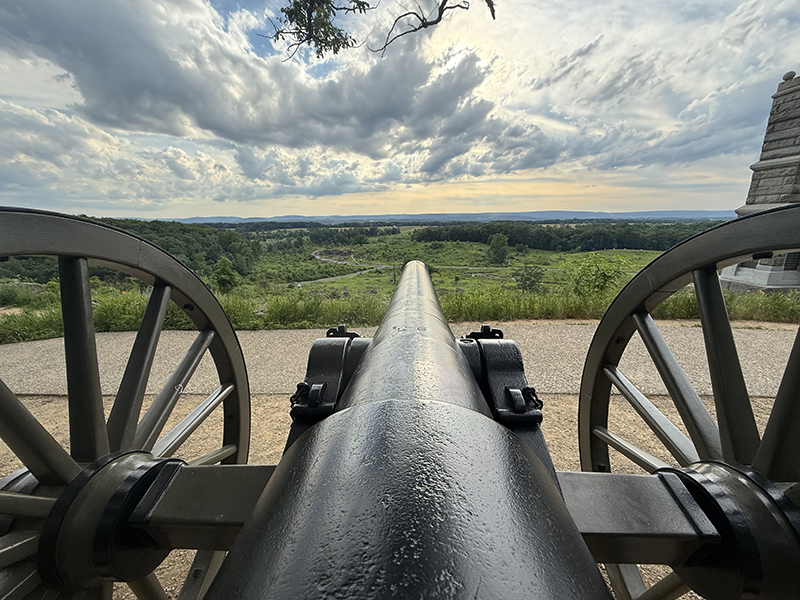
In photo: Civil War cannon overlooking the valley from Little Round Top
To truly understand the scale of the conflict the Sisters stepped into, the group began their day by immersing themselves in the history of the battlefield. The exploration began at the Gettysburg National Military Park Museum and Visitor Center. The group experienced the breathtaking Cyclorama; A 360-degree, multimedia presentation that vividly places viewers in the center of Pickett's Charge before moving through the exhibits outlining the timeline of the war through individual stories of the soldiers and civilians caught in its wake.
Next, the group visited the Gettysburg National Cemetery on Cemetery Hill. Standing on the high ground successfully defended by the Union, it was deeply moving to stand in the area where President Lincoln delivered the Gettysburg Address, giving new meaning to the sacrifices made on that soil.
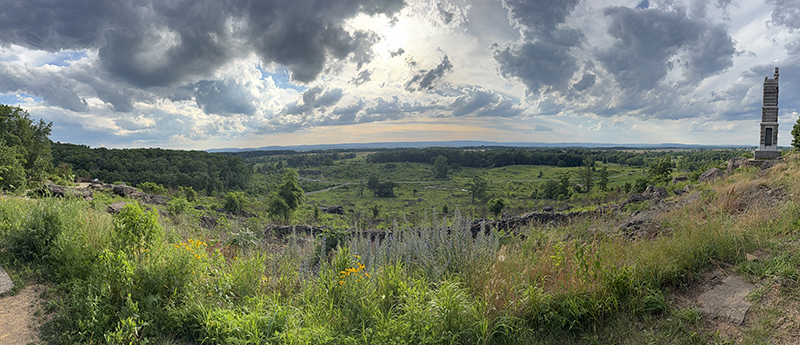
In photo: Panoramic photo from Little Round Top overlooking the valley
The day ended with a driving and walking tour across the battlefields. Standing atop Little Round Top and looking out over the quiet valley that once saw a brutal battle, the beauty and serenity of the landscape really brought home the human cost of the war—and the horrors faced by soldiers on both sides. For a few people in the group, that history felt especially close each morning when they looked out their hotel windows and realized they were staring directly at Cemetery Hill.
Day 3: “Charity Directs the Hands” in Baltimore, Maryland
The final leg of the pilgrimage concluded in Baltimore under the theme "Charity Directs the Hands", that ties St. Elizabeth’s beginnings to the Mount’s Cincinnati roots. The journey began at America’s first cathedral, the Baltimore Basilica, which holds deep connections to the Mount’s heritage. It was here that Archbishop John Carroll initially encouraged her to open a school for young women, and where Archbishop Purcell of Cincinnati was consecrated before supporting the official establishment of the Sisters of Charity of Cincinnati. Archbishop James Roosevelt Bayley, St. Elizabeth’s nephew, consecrated the walls of the Cathedral in 1876 and was a supporter of Mother Margaret George, a Sister of Charity of Cincinnati, and sent many novices to her for training.
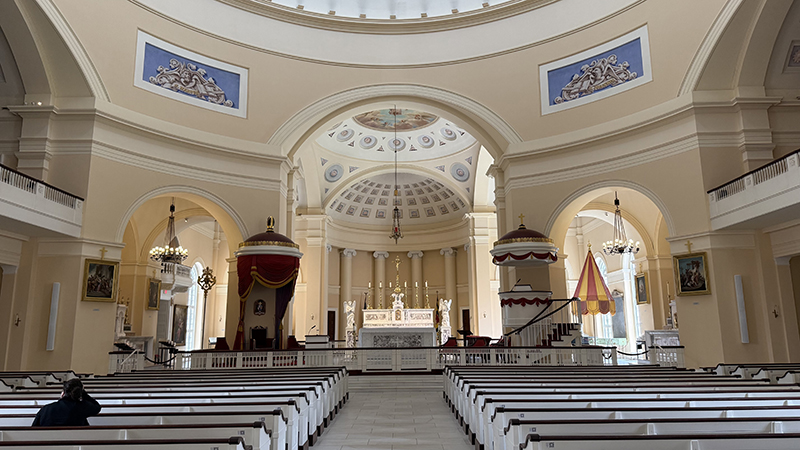
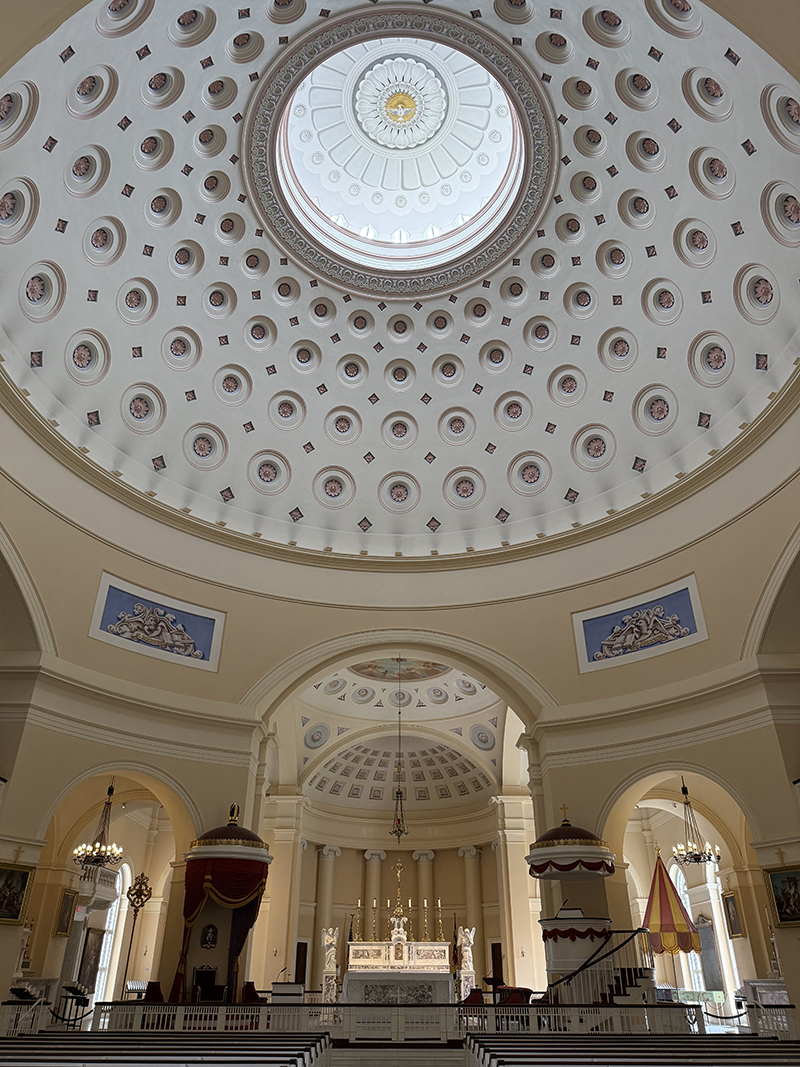
In photo: The Baltimore Basilica. The alter contains relics from seven national saints, including St. Elizabeth
Descending into the Basilica's Undercroft, the group experienced a connection to modern faith history by visiting a pew used by St. Teresa of Calcutta and kneeling at the exact kneeler used by St. John Paul II.
Further, the exploration then moved to Paca Street to visit the historic Mother Seton House. In this home, St. Elizabeth lived with her three daughters before they moved to Emmitsburg and began the Sisters of Charity Community. It was here that she met Samual Cooper, a wealthy convert and seminary student. Cooper provided her with the funding to purchase land in St. Joseph's Valley, which inspired her monumental move just one year later to Emmitsburg, Maryland where her mission could permanently expand.
While living in her home on Paca Street in Baltimore, St. Elizabeth dedicated much of her mission to providing free education and religious instruction to the children of needy immigrant families. She established a separate school for local, impoverished girls, and many of these children were from newly arrived immigrant families who could not afford an education (Betty Ann McNeil D.C., 1996).
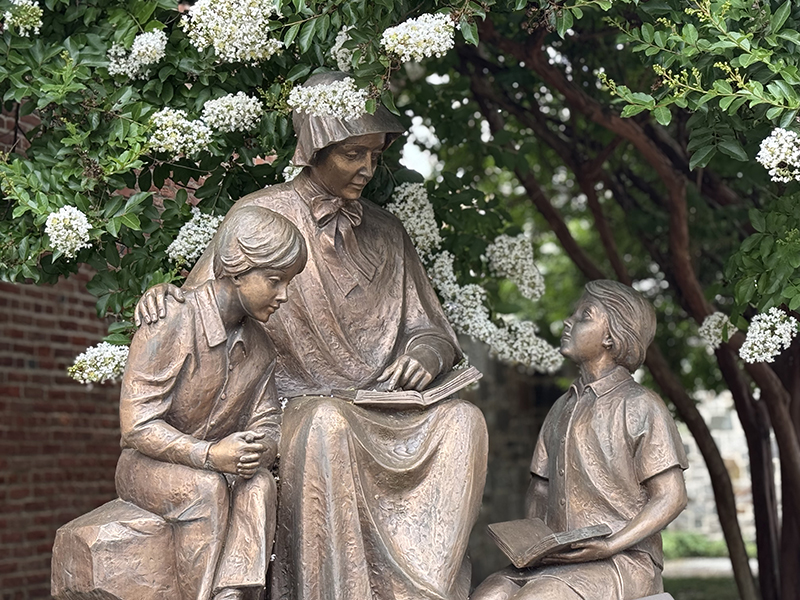
In photo: Statue of St. Elizabeth teaching from the Paca Street House
“Baltimore grounded it all in something deeply personal,” Hofmeyer reflects. “Standing at the Paca Street House, learning that [St. Elizabeth] built much of this mission in service to the education of immigrant communities. My Italian, German, and Irish Catholic family's story aligns with her mission of service to immigrant communities. The Catholic education and values that shaped generations of my family trace back to exactly this tradition. For that gift, I am more grateful than I can easily put into words.”
Finally, the three-day pilgrimage culminated with a visit to Ft. McHenry National Park where they visited a museum exhibit and walked the historic grounds that inspired the National Anthem during the War of 1812.
A Mission Renewed: Walking Forward in Faith and Service
Walking in the footsteps of St. Elizabeth Ann Seton allowed the pilgrimage group to see how deeply the roots of the Sisters of Charity still feed the mission of Mount St. Joseph University today, and the impact that her life continues to have on the Mount Community, throughout the Greater Cincinnati Region, and across the nation. The historic spaces they visited were reminders of what it means to serve the common good. Re-energized by the origins of the Sisters of Charity mission who came before them, the participants return ready to live those same habits of resilience and compassion.
Source: https://via.library.depaul.edu/cgi/viewcontent.cgi?article=1174&context=vhj